
The Body Must Serve the Music

A guitar's body is not only an acoustic chamber. It is also something the player must live with physically. A guitar s sound is shaped not only by wood and bracing, but also by how the player touches it. The angle of the arm affects attack, the ease of the left hand affects phrasing, and the way the guitar rests against the body affects breathing. Comfort is performance. It is achieved through deliberate architectural decisions designed to allow the player to give more to the instrument, and for the instrument to give more back.
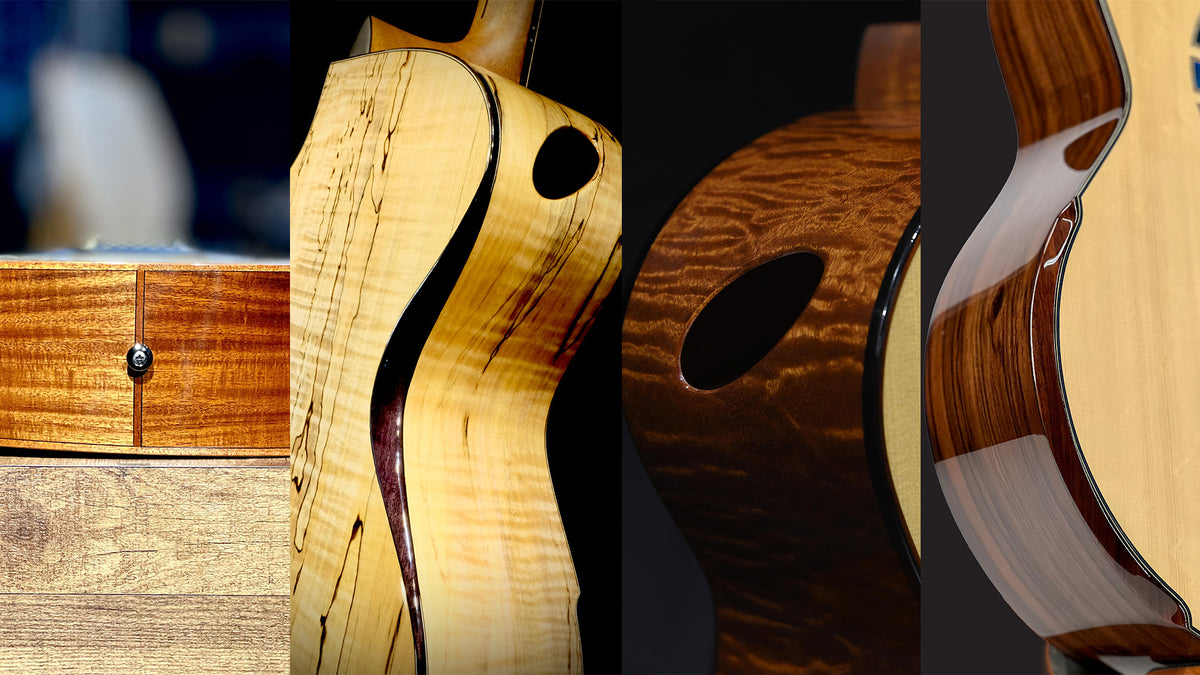
The Manzer Wedge
A larger body can offer depth, air, and power, but it can also become physically demanding. By making the guitar shallower on the player's side and deeper on the far side, the body retains its air volume while sitting more naturally against the ribs. The guitar becomes bigger in voice than it feels in the hands.
The Back Bevel
On a traditional body, the edge can feel hard over time, and the forearm can dampen the top if it rests too heavily on the vibrating surface. When the back is part of the instrument's acoustic life, giving it room to move matters.
The Laskin-Inspired Armrest
The armrest gives the arm a more natural surface and keeps the forearm from interfering with the top, allowing the soundboard to move more freely. A guitar projects forward, meaning the audience often hears more of the instrument than the player does.
The Soundport
By allowing some of the guitar's voice to reach the player more directly, the soundport creates a closer feedback loop between touch and sound.

The Neck, Setup & PLEK
The neck is where trust becomes physical. A great voice can easily be hidden behind poor playability. If the action, fret leveling, saddle, and intonation are not right, the player cannot fully access the instrument' potential. To ensure absolute trust between the player s hands and the instrument, every Hozen guitar undergoes setup using a German-engineered PLEK machine. This ultra-precision tool assesses scale length, fingerboard radius, and fret dimensions under playing tension. However, like any tool, the machine must serve human judgment. A low action is not automatically better for every musician; an aggressive flatpicker requires a different setup compared to a delicate fingerstylist.

Resonance & Responsibility
A guitar begins with a small amount of energy. A string is plucked. The saddle receives the vibration. The bridge passes it into the top. The soundboard moves, the air inside the box responds, and the back begins to take part in the conversation. What we hear is not one piece of wood. It is a system. This is why a guitar cannot be understood by its specifications alone. A spec sheet can name the spruce, the rosewood, the bracing pattern, the scale length, the finish, and the nut width. It can describe the instrument before it is played, but it cannot tell us whether the guitar is alive. That has to be felt.